Non-Binding Resolution
This question does not create law. It has no legal force. Its only purpose is symbolic — to create a mindset that Yarmouth is a sanctuary city and to signal to bring more illegal aliens to town. It is a dog whistle dressed up as constitutional language.
Question 4 was filed via the citizen petition route and was never placed on the April 28 Town Meeting agenda for public discussion. It comes straight to the May 19 ballot with no public deliberation, no debate, and no amendment process. Just a checkbox.
Not one single immigrant has addressed the Board of Selectmen stating they don't feel welcome in Yarmouth. Legal immigrants are welcome — they always have been. Illegal immigrants would not risk coming forward to make such a statement, because they are here illegally. This question solves a problem that does not exist.
Massachusetts law sets two very different bars for ballot questions:
64.7× difference in the standard of proof. They chose the path of least resistance — 35 signatures instead of 2,265 — because they knew they couldn't get real support.
Town Administrator Robert Whritenour confirmed in writing on March 20, 2026 that this petition is "directly related" to the sanctuary-style resolution this board previously rejected. Same objective — different mechanism.
This item was not on any projected agenda as of March 6th. It was not discussed at the March 10th meeting. It does not appear anywhere in the 473-page March 10th meeting packet. It showed up on the March 24th agenda on March 20th — four days' notice — on the same night the board signed the election warrant. That is not adequate public notice for a question of this nature.
A sanctuary-style "human rights resolution" is brought before the Yarmouth Select Board. Yarmouth residents show up and kill it. Cheryl Ball identifies the use of the word "visitor" in the resolution — language designed to extend protections to undocumented immigrants. The resolution is rejected.
"Every protection listed in this resolution already exists under the United States Constitution, the Massachusetts Constitution, and federal and state civil-rights law. So what is this resolution actually for? It is social-justice activism packaged as municipal governance." — Testimony opposing the resolution
Having failed at the Select Board, Susan Gregory-Davis files a petition under MGL c.53 §18A. This law allows a non-binding ballot question with just 35 signatures — bypassing the Select Board entirely. No public hearing required. No debate. Just 35 names on a piece of paper.
The petition is filed with the Town Clerk. The 35 signatories: 22 Democrats, 13 Unenrolled, 0 Republicans. Median age: 73. Nine pairs live at the same address — effectively just 25 unique households. At least 8 are confirmed donors to Julian Cyr. Several registered to vote in 2024–2025 — they moved here and immediately started pushing this agenda.
YRTC Secretary Billy Kirwin emails the Select Board asking for the petition text and details.
Robert Whritenour responds in 63 minutes, confirming this petition is "directly related" to the previously defeated sanctuary resolution. Email CC'd to the entire Select Board. They all knew. They voted YES anyway.
The ballot question was not on any projected agenda as of March 6th. It was not discussed at the March 10th meeting. It does not appear anywhere in the 473-page March 10th meeting packet. It showed up on the March 24th agenda on March 20th — four days' notice — on the same night the board signed the election warrant.
Despite knowing this is the same defeated resolution with a different label, four members vote YES. Only Tracy Post votes NO. 80% of your Select Board elevated 35 petition signatures over 22,842 registered voters. The question goes on the May 19 ballot with zero public deliberation.
Question 4 appears as a non-binding advisory question. No public debate at Town Meeting. No discussion. No amendment. Just a checkbox — and your voice. Make it count.
Four members voted to place this question on your ballot. One stood up and said no.
Local government is supposed to be non-partisan. Select Board decisions should be made for the benefit of the entire town — not for one political group. Judge for yourself whether that standard is being met.
The Select Board was not required to vote on placement — MGL c.53 §18A mandates placement with valid signatures. But they chose to vote anyway, putting their names on the record. Remember these names on Election Day.
Registered to vote in Yarmouth August 2024. Filed the sanctuary petition March 2026.
| Metric | Data |
|---|---|
| Democrats | 22 |
| Unenrolled | 13 |
| Republicans | 0 |
| Median age | 73 |
| Registered 2024–2025 | 6 |
| Same-household pairs | 9 |
Nearly half of the signatories are from a single precinct.
This is not a community movement. This is an organized political operation by a small group of transplants with a decades-long activist agenda.
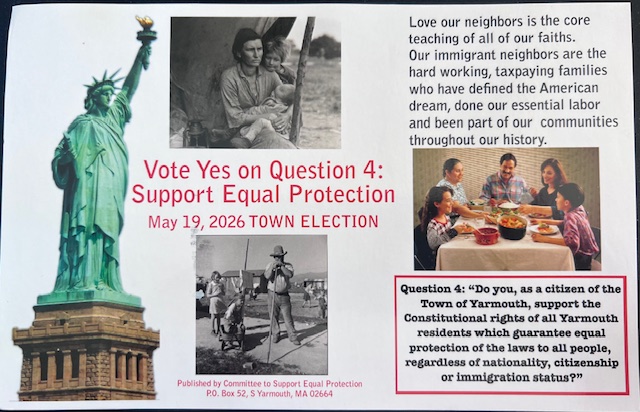
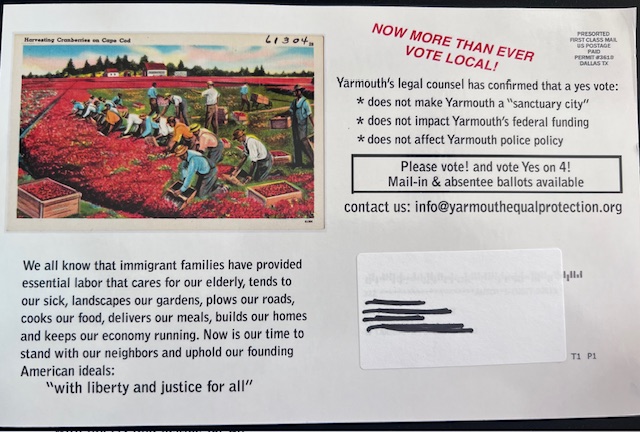
The same group that bypassed Town Meeting with 35 signatures is now mass-mailing voters. We’ve seen the card. Two things stand out immediately.
As best we can tell, the “Committee to Support Equal Protection” mailer was distributed only to registered Democrats in Yarmouth. If this question were genuinely about the United States Constitution and equal protection — rights that already apply to every Yarmouth resident regardless of party — the mailing list would not be partisan.
A targeted Democrat-only mail drop is the receipt: this is a partisan political operation, not a constitutional concern. It has no place on a Town ballot decided by all Yarmouth voters of every party and no party.
“We all know that immigrant families have provided essential labor that cares for our elderly, tends to our sick, landscapes our gardens, plows our roads, cooks our food, delivers our meals, builds our homes and keeps our economy running.”
That is the imagery and the wording they chose — pairing a vintage cranberry-harvest postcard with copy that reduces immigrants to a list of services they perform for us. Cares for our elderly. Tends to our sick. Plows our roads. Cooks our food. That framing is not respect. It is the framing of a labor class that exists to serve. Read it twice and ask whether this is how the people who claim to speak for immigrants actually see them.
Nowhere in this mailer — front or back — do the authors draw a line between legal immigrants (who came through the process, work, pay taxes, and are part of the community) and illegal immigrants (who entered or remained in violation of federal law). Every legal protection they claim to invoke already applies to legal residents. They will not acknowledge the difference because the difference would defeat their argument: this question exists to extend protections beyond what current law already provides — to people whose presence is not lawful. That is what a yes vote on Question 4 actually signals, regardless of how the mailer is dressed up.
Even non-binding resolutions signal policy intent to federal agencies. A "yes" vote tells Washington that Yarmouth intends to obstruct immigration enforcement — and puts federal funding on the table.
If this question passes, it will be waved around as proof that "Yarmouth supports sanctuary policies." It will be cited at future Select Board meetings. It will be used to justify further political action — just like the activists planned from the beginning.
This is not about constitutional rights. Those already exist. This is about creating political leverage from a low-turnout election using a 35-signature loophole. Vote NO on Question 4.
Get straight-talk updates on the May 19 ballot — and on the future Yarmouth issues that follow. Email or text. Two separate opt-ins, both optional, both opt-out anytime. Yard sign optional too.
Sign Up for Updates →Show up on May 19. Vote NO on Question 4. Make your voice louder than their loophole.